
Rename Downloaded Images From CSV
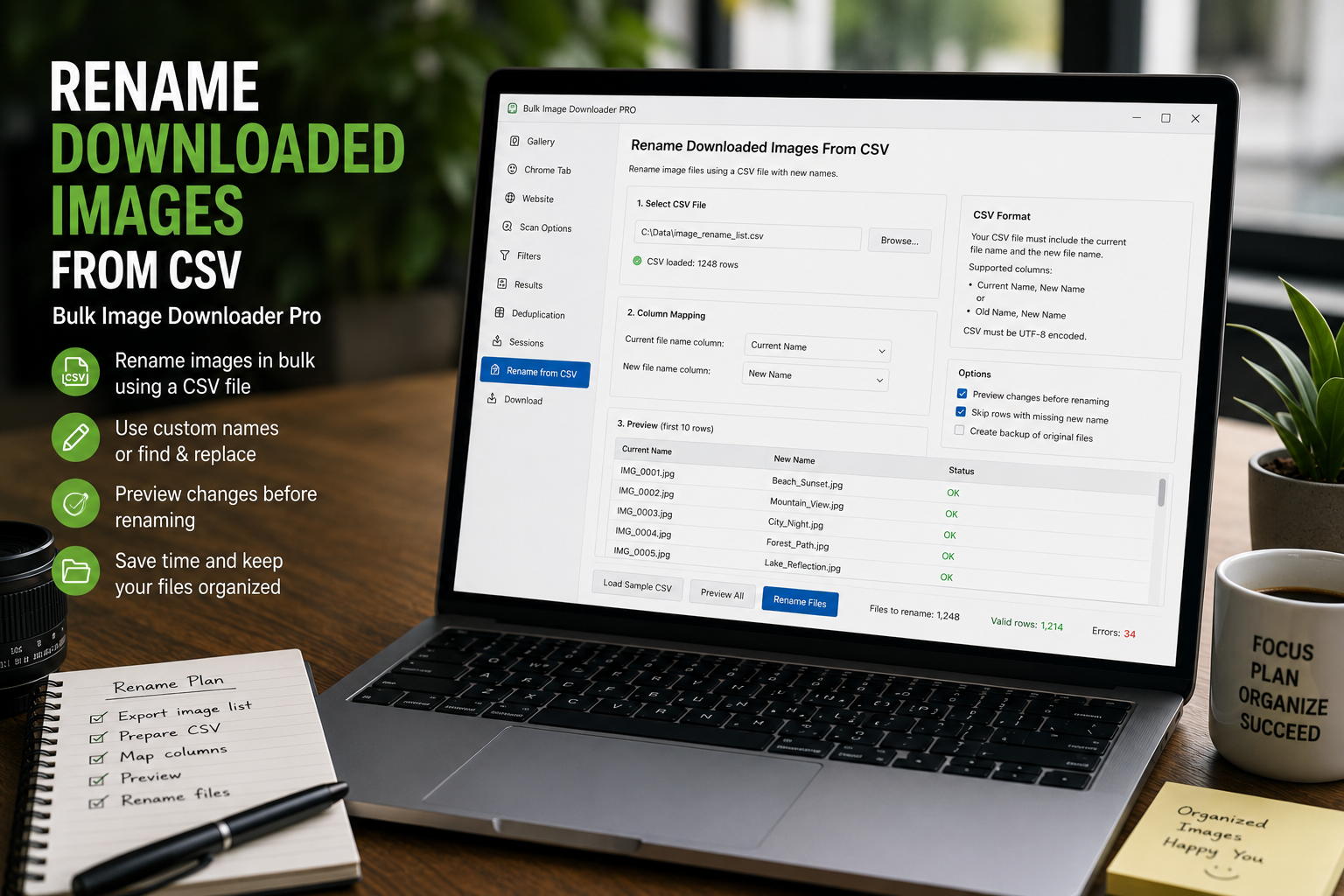
Sometimes automatic filename patterns are not enough. Product images may already have SKU names, migration names, client-approved labels, or spreadsheet IDs. In that case, the cleanest workflow is to rename downloaded images from CSV so each URL receives the exact filename you planned before the download starts.
Bulk Image Downloader From URL List supports this through Custom Filenames from File inside the Filename Constructor on the options page.
Use CSV or TXT when names are already decided
Custom filename files are useful when the filename is not something the extension should generate from a sequence, URL, or website name. You already know the final names, and you want the downloader to apply them in the same order as the task URL list.
The feature accepts CSV or TXT files with one filename per line.
Match the filename count to the URL count
The important rule is count and order. If the task has 80 valid URLs, the uploaded filename file needs 80 filenames. The first filename is applied to the first URL, the second filename to the second URL, and so on.
The extension validates this before the task runs. A mismatch is treated as an error because one missing row would shift the naming for every file after it.
Leave extensions out of the filename file
The custom filename list should contain names without file extensions. The extension adds the output extension automatically, based on the downloaded or processed file.
Keep the names clean too. Avoid characters that are unsafe in filenames, such as slashes, quotes, question marks, pipes, and other reserved symbols.
A practical spreadsheet workflow
- Put the image URLs in one column and the desired filenames in another.
- Sort both columns together so the order stays aligned.
- Paste or import the URLs into a download task.
- Export the filename column as CSV or TXT, one name per row.
- Enable Filename Constructor and add Custom Filenames from File.
- Upload the filename file and fix any validation mismatch before running.
When this is better than generated names
Use CSV-based names when filenames need to match a catalog, a CMS import, a product feed, an affiliate dataset, a client brief, or an existing asset library. Use the regular Filename Constructor when you only need a pattern such as website plus sequence.
For planned names, the CSV or TXT file becomes the source of truth.
For token-based naming, read rename downloaded images automatically. For cleaning final names after construction, see filename cleanup rules.
Bulk Image Downloader From URL List is useful here because the hard part is rarely “save one file” — it is cleaning and repeating the job without rework.
When the list is ready, run it through Bulk Image Downloader From URL List Extension so naming rules, folders, and filters stay consistent across the batch.